Attio's onboarding, deconstructed
If you spend time on Reddit, read the Ben Evans newsletter, or have gone looking for CRM software lately, you've almost certainly run into Attio's marketing push. It is everywhere right now, and far from subtle.
As it happened, my inbox had captured what comes after the click. A full two weeks of Attio's onboarding flow. So I read all fourteen emails in order, to answer one question: how does Attio actually turn a trial signup into a paying subscriber?
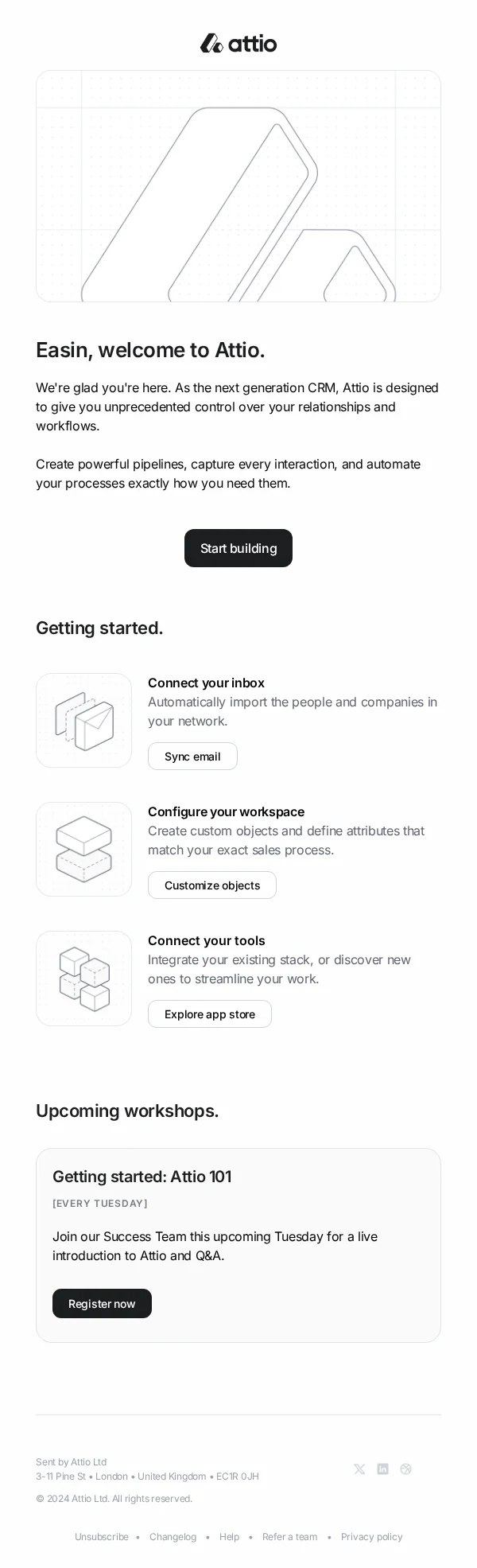
Attio's onboarding sequence is doing something most SaaS brands talk about and rarely commit to: it is trying to teach, not merely convert. Over 14 days, the emails move with a kind of patient confidence from welcome note to product education to sales pressure, and the result is a funnel that feels less like a funnel and more like a guided apprenticeship. Which is, inconveniently for everyone else, a better way to sell software.
The pacing
What stands out first is the pacing. Attio doesn't open with pricing, scarcity, or the usual theatrical urgency. It starts with reassurance: welcome emails, setup help, a real contact on hand, and a clear promise that the product can be shaped around the user's workflow. That matters because Attio is not selling a simple, fixed tool. It's selling a CRM that claims control, flexibility, and automation without the usual implementation hangover. So the first job is not “buy.” It's “understand what this thing can do for me.”
Task-based education
That's where the sequence becomes notably disciplined. The emails are built around the jobs-to-be-done framework, whether they name it or not. Each touchpoint isolates a practical task: get started, learn the building blocks, automate workflows, read reports, use the Chrome extension, send emails from inside Attio. This is not feature dumping. It is task-based education, which is a subtler and more useful form of persuasion. Instead of asking subscribers to admire the platform, Attio keeps asking: what are you trying to get done, and how quickly can this product disappear into that motion?
One task per lesson
1/6 & 4/6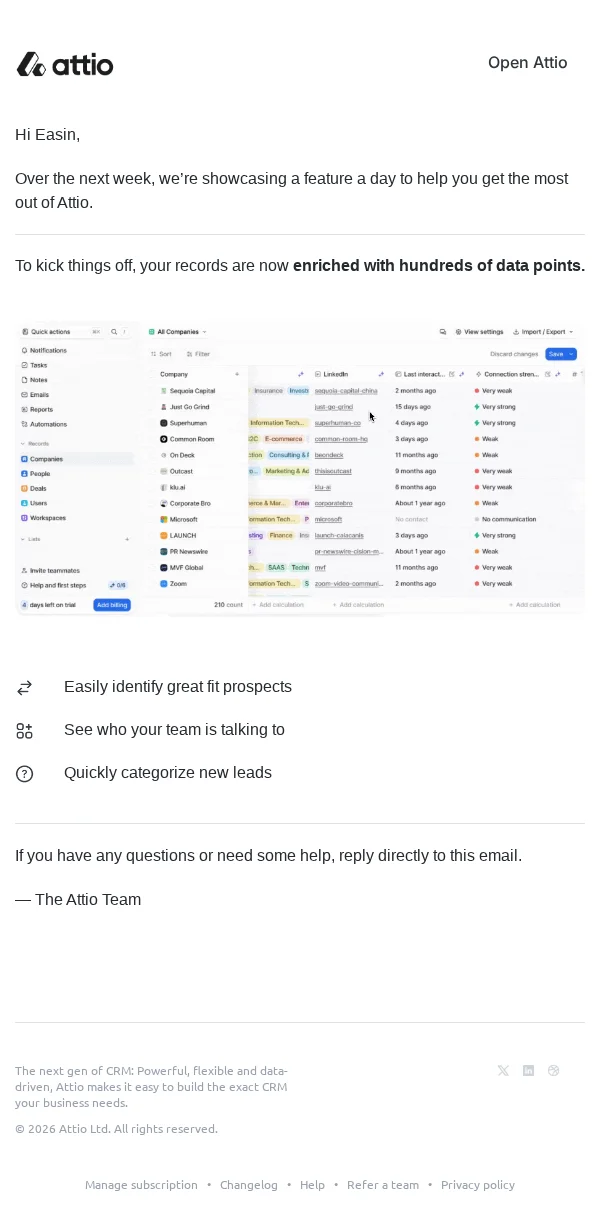
Getting started with Attio
The first job, isolated. Not “here is everything” but “here is the one thing to do next.”
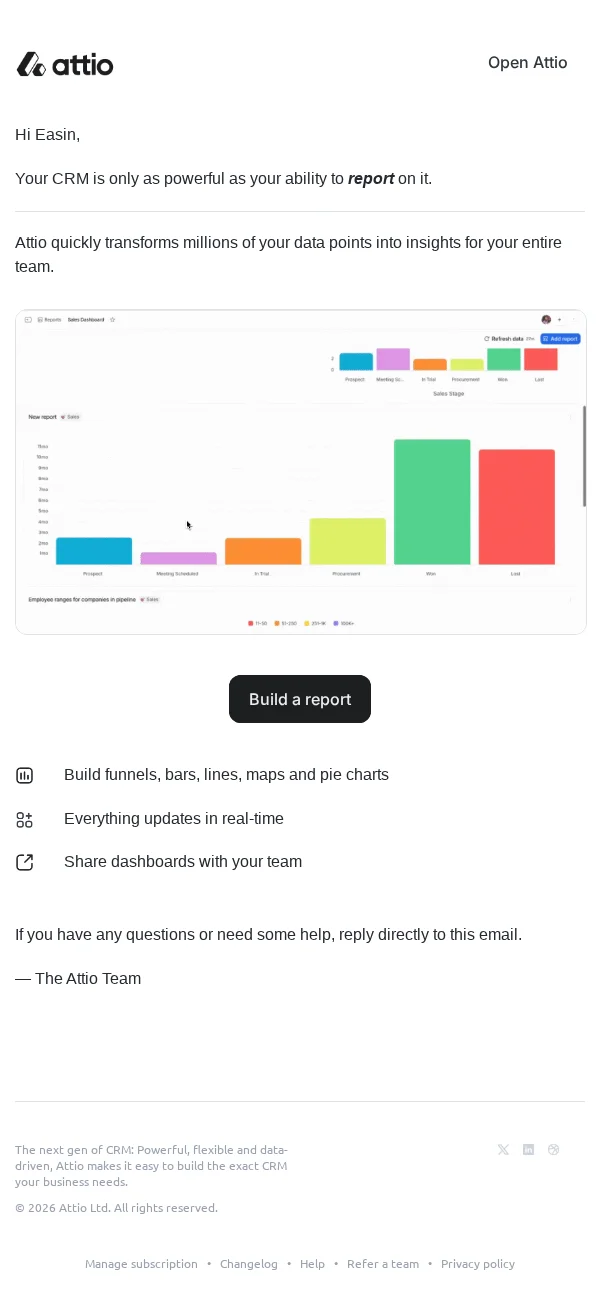
How reports in Attio work
Another discrete task (read your data), framed as something to do, not a feature to admire.
Motion as proof
The effect is helped enormously by the visual language. Attio is leaning hard into animated screen recordings and product UI demonstrations, and rightly so. In a category full of abstract promises, motion is proof. A still screenshot says, “Look at the interface.” A short animated demo says, “Watch the interface do the thing.” That distinction matters. The product is technical and modular; the email should reduce uncertainty, not decorate it. The animations give the onboarding sequence a sense of immediacy and competence. They make the software feel already in use, which is a nice trick when you're trying to persuade someone to start using it.
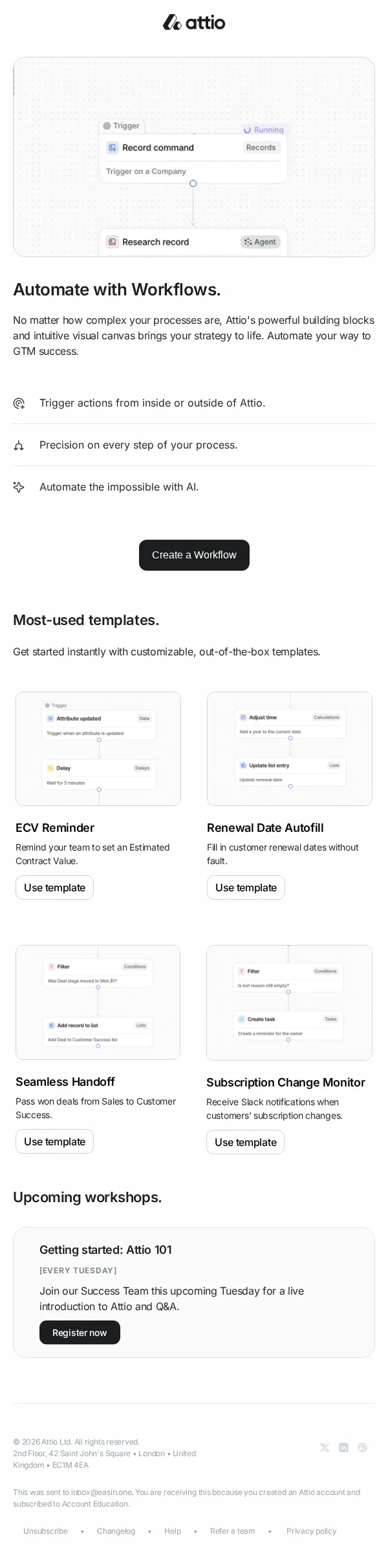
Attio automations
Captured here as a still; in the inbox the workflow plays as a short screen recording. “Watch the interface do the thing.” The product made to feel already in use.
Open the full email →The friendly note that doesn't sound like a campaign
What's clever, and slightly disarming, is the mix of polished product education with plain-text emails that feel handwritten. Attio repeatedly breaks the pattern of branded marketing copy with replies that look like a real person sat down, opened their inbox, and typed “Re:” because that is apparently still the most effective interface in email. These messages are conversational, low-friction, and human enough to suggest actual support rather than automation pretending to be support.
That tone does important work. It softens the product-led sequence, which could otherwise feel coldly instructional. The emails don't just explain features; they imply a relationship. There's a real contact, a slot to book, help available before the trial ends, and eventually a forum invitation to join the Attio Community. In other words, the brand is not only onboarding users into software. It's onboarding them into a system of support, advice, and peer validation. That's smart because CRM adoption is rarely a solo sport. Teams need confidence, not just access.
Plain text, then belonging
Day 10 & Day 13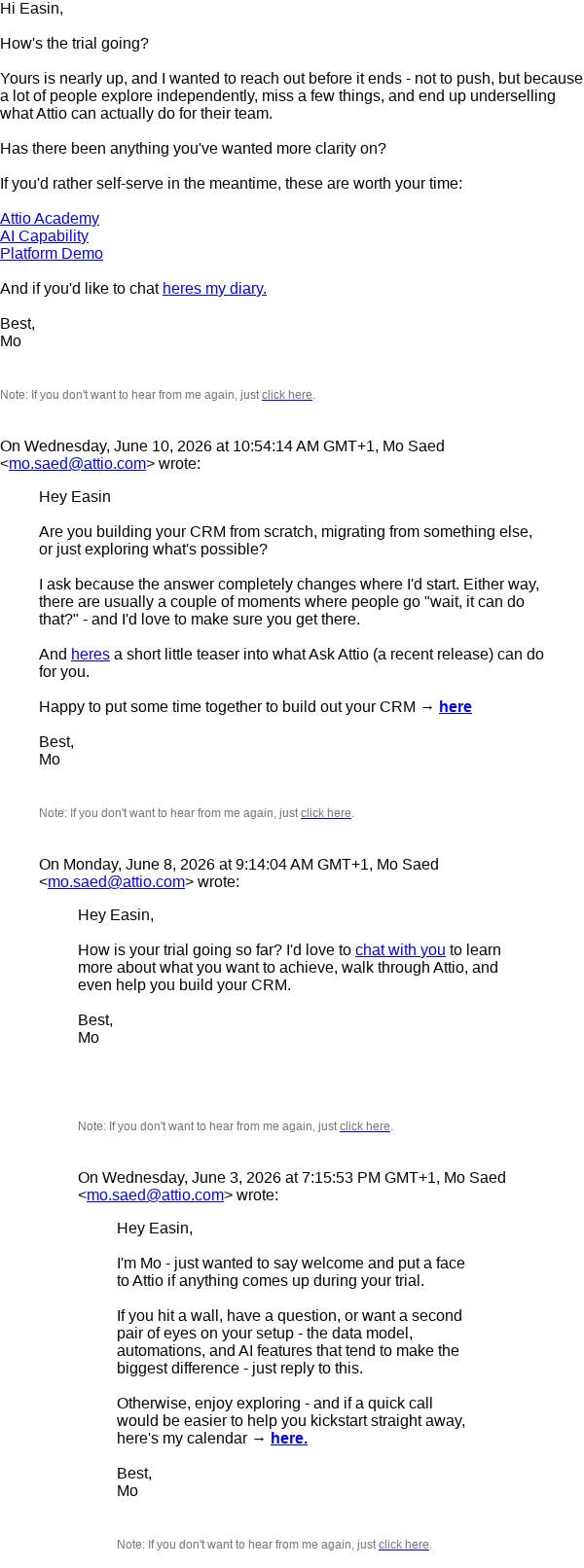
“Re: Welcome to Attio”
No branding, no hero image, just a plain note that looks personally typed. Support, not automation pretending to be support.
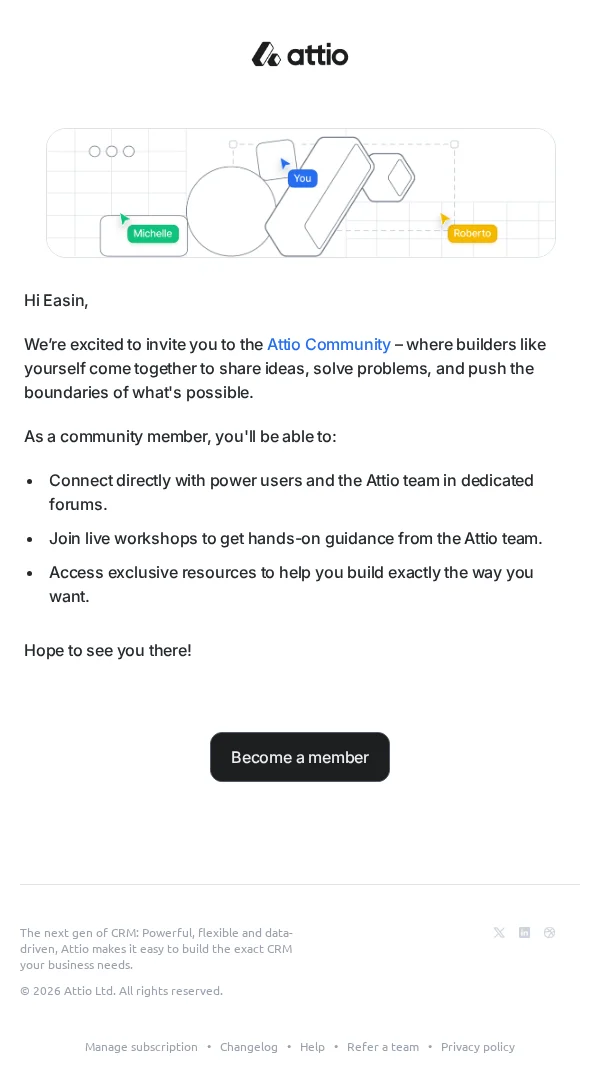
Join the Attio Community
Onboarding into more than software: a system of support, advice, and peer validation. CRM adoption is rarely a solo sport.
The emotional arc
Attio also understands something many brands miss: the emotional arc of a trial is not linear. It starts with curiosity, moves through confusion, then either momentum or avoidance. The sequence mirrors that reality. Early emails are generous and explanatory. Mid-sequence, the product value gets more concrete: automation, reporting, browser access, sending emails, workflow templates. Only at the end does the sales machinery arrive, once the user has been shown enough utility to make the ask feel earned rather than opportunistic. The trial-ending emails are still fairly restrained, which is refreshing. Even the urgency is measured; Attio doesn't scream. It simply closes the door behind the user and asks whether they'd like to remain inside.
Selling after the lesson lands
This delayed sales push is the strongest strategic choice in the sequence. Attio waits until it has established the product's logic before asking for payment or extension. That sequencing is not accidental. It reflects a basic truth about sophisticated software: users rarely convert because they were told a product is powerful. They convert when they can picture the workflow they'd be replacing. Attio spends the first half of the sequence building that picture.
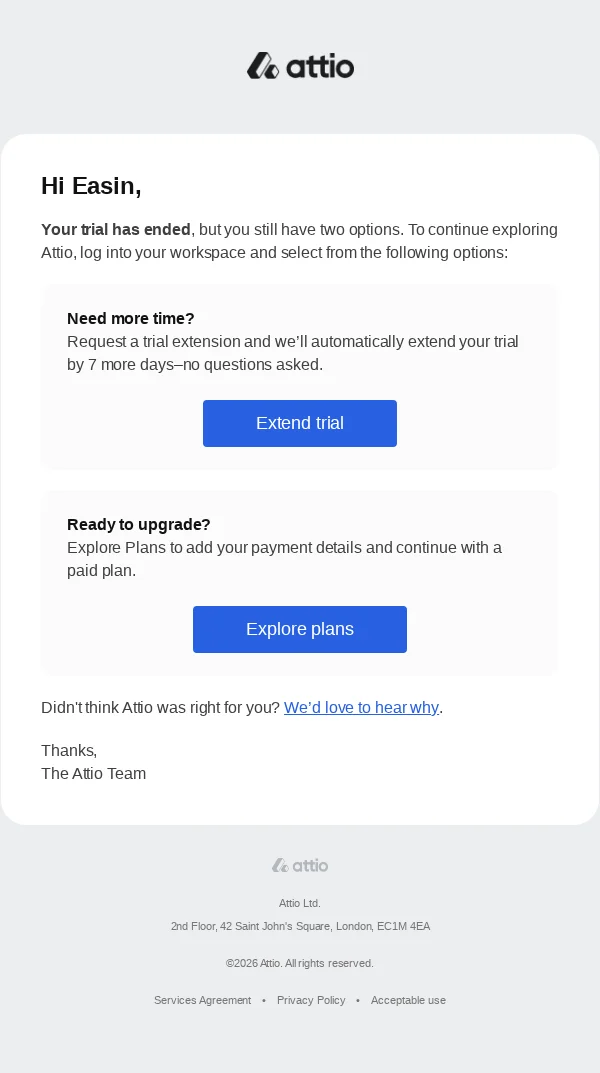
Your Attio trial has ended
The ask arrives last, and quietly. No scolding, no scream. It simply closes the door behind the user and asks whether they'd like to stay inside.
Open the full email →Quiet strengths
There are a couple of other quiet strengths worth noting. First, the brand consistency is unusually tight. The design system is spare, monochrome, and clean, with one-column layouts that put the product at the center. There's no decorative excess competing with the message. It reads like a company that knows its audience doesn't need confetti. Second, the sequence is surprisingly modular. The emails can function as standalone lessons, but together they form a coherent curriculum. That means each message does useful work on its own while still contributing to the larger conversion path. A rare instance of an email strategy that respects the reader's memory.
Why it works
Attio's onboarding journey works because it treats conversion as an outcome of comprehension. It uses motion to demonstrate, plain text to humanize, and task-based education to create momentum. The sales ask comes last because it should. That's not just good email marketing.
It's basic dignity, which remains a niche tactic in SaaS.
Appendix
The sequence, in full
14 emails · Day 1 – 15